Compare Auto Lensometer & Ophthalmic Diagnostic Equipment
Setting up an optical dispensary, modernizing an optometry practice, or outfitting a secondary eye care hospital requires precise, high-throughput diagnostic instrumentation. In ophthalmic diagnostics, refractive errors account for over 65% of all outpatient consultations across India. Rapid, automated, and operator-independent measurement of spherical power, cylindrical astigmatism, axis alignment, and corneal curvature has become the cornerstone of clinical workflow. However, biomedical procurement teams and optometrists often face a significant dilemma: whether to invest in standalone automated refractometers, integrated auto ref-keratometers (ARK), or digital wavefront auto lensometers—and how to balance capital investment with optical measurement accuracy.
"In high-volume optical shops and eye OPDs across Tier-1 and Tier-2 Indian cities, manual focimeters and subjective streak retinoscopy are no longer viable for high patient turnover. The primary clinical bottleneck occurs when measuring modern multi-focal progressive addition lenses (PALs) and high-index (1.67 / 1.74) aspheric spectacles. Older red-light lensmeters require manual Abbe number compensation, leading to frequent axis and cylinder shifts. Upgrading to a digital Hartmann wavefront sensor with a 545nm green LED light source eliminates chromatic aberration and cuts lens reading time from 90 seconds to under 3 seconds per pair."
1. 2026 Auto Lensometer & Auto Refractometer Price Matrix in India
Ophthalmic diagnostic equipment pricing in India depends heavily on sensor architecture (Hartmann Wavefront matrix vs rotary prism), light source wavelength (545nm Green LED vs standard broad-spectrum diode), corneal keratometry integration, and mechanical ergonomics. Below is the 2026 institutional benchmark pricing for clinical-grade ophthalmic equipment supplied by SMD Medicare:
| Equipment Model | Category & Sensor Architecture | Measurement Spectrum | Price (INR Excl. GST) | Best Suited For |
|---|---|---|---|---|
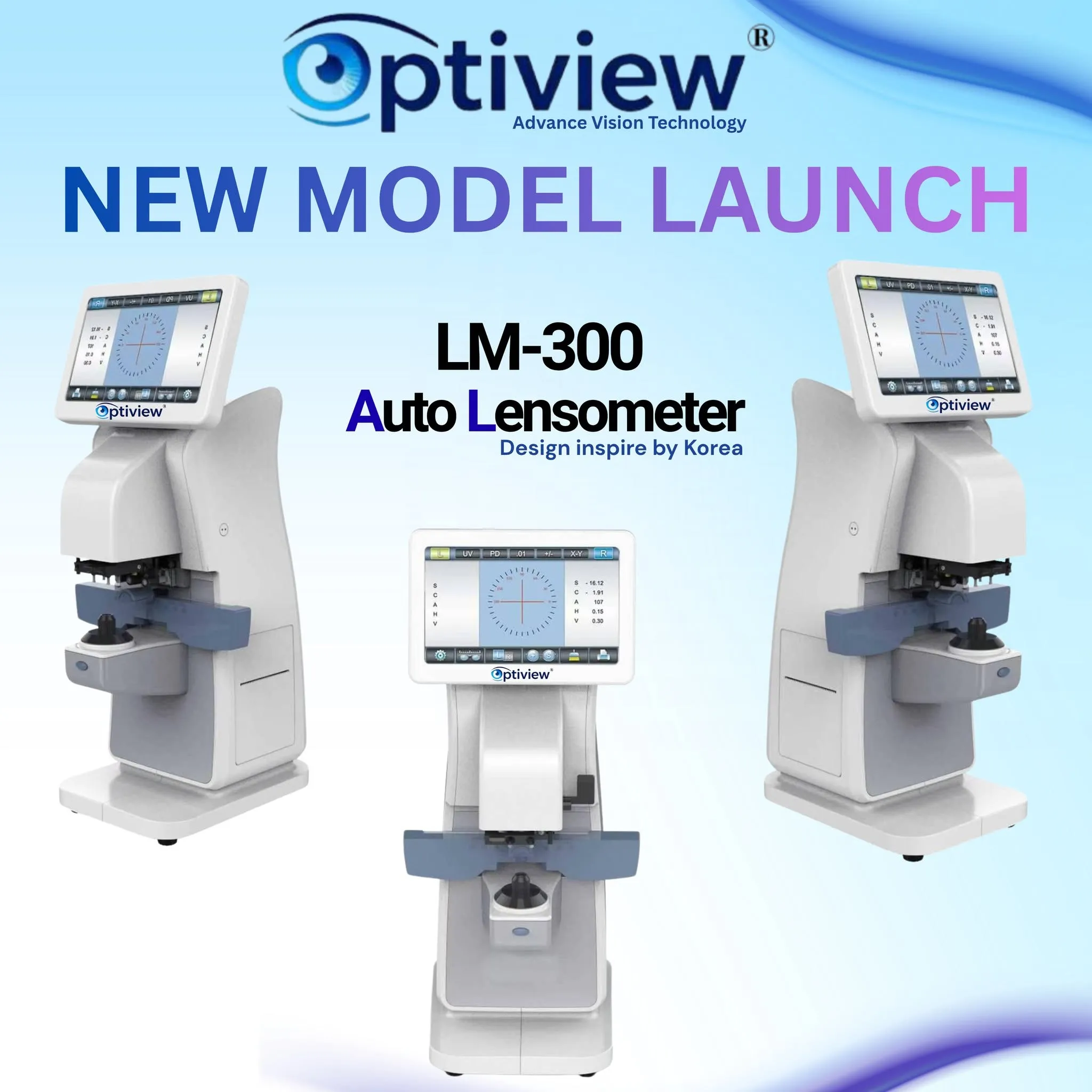
| Optiview LM-300 | Auto Lensometer (Hartmann Wavefront Array, 7" Color Touchscreen) | Sphere: ±25D, Cyl: ±10D, UV (0-100%), Blue Light HEV | ₹54,000 | Optical Retail Stores, Hospital Refraction Labs, Lens Fitting Centers |
| Optiview LM-200 | Digital Auto Lensometer (Multi-Point Optical Grid, Auto Memory) | Sphere: ±25D, Cyl: ±9.99D, Progressive Mode | ₹52,300 | Standard Optical Dispensaries & Secondary Clinics |
| Optiview AR10 | Auto Refractometer (High-Resolution Hartmann Wavefront Sensor) | Sphere: -20D to +20D, Min Pupil: 2.0mm, Auto-Fogging Target | ₹2,04,000 | High-Volume Eye OPDs, Refractive Surgery Screening |
| Optiview KR10 | Auto Ref-Keratometer (Dual CCD Array, Corneal Curvature R1/R2) | Refraction + Keratometry (Radius: 5.0 - 10.2mm, Astigmatism: 0-180°) | ₹2,16,000 | Comprehensive Eye Hospitals, Contact Lens Fitting Clinics, IOL Pre-op |
| Matrix R20 | Auto Refractometer (Precision Rotary Prism Technology) | Sphere: -20D to +20D, Cyl: ±8D, Motorized Chinrest | ₹1,80,000 | Community Eye Centers, Diagnostic Nursing Homes, Training Labs |
| Matrix KR20 | Auto Ref-Keratometer (Dual Mire Rings, Automatic Tracking) | Refraction + Peripheral Keratometric Curvature Mapping | ₹2,04,000 | Mid-Scale Eye Care Centers & Specialty Contact Lens Practices |
| EyeCare Haag Slit Lamp HD | Haag-Streit Type Slit Lamp (5-Step Galilean Converging Optics) | Magnification: 6x to 40x, Slit Width: 0-14mm Continuous | ₹42,000 | Anterior Segment Examination, Corneal Foreign Body Triage |
| Opticare Doctor Chair Unit | Motorized Ophthalmic Examination Unit (Chair + Sliding Arm Console) | Hydraulic Vertical Lift, 180° Swivel, Integrated Projector Pole | ₹98,400 | Complete Optometry Lane & Ophthalmologist OPD Consultation Room |
2. Auto Lensometer Technology: Why Green LED (545nm) Hartmann Sensor Matters
Traditional manual lensometers (often called focimeters) rely on the human eye to align a target crosshair through an eyepiece reticle. This method has three critical flaws in modern optical practices:
- Operator Parallax & Fatigue: Different technicians reading the same cylinder lens can produce discrepancies of 0.25D to 0.50D and up to 5° in axis alignment due to accommodative fatigue.
- Abbe Number Incompatibilities: Standard lensmeters utilize broad white light or infrared diodes. When testing modern ultra-thin lenses (polycarbonate with Abbe value 30 or 1.74 index with Abbe 32), chromatic dispersion causes false spherical power readings unless manually compensated.
- Progressive Addition Lenses (PAL) Identification: Progressive lenses feature graduated power without visible bifocal lines. Attempting to mark the distance optical center and near addition zone manually with a focimeter is time-consuming and error-prone.
Modern auto lensometers such as the Optiview LM-300 solve these challenges through a Hartmann-Shack multi-point wavefront sensor paired with a monochromatic 545nm green LED light source. The 545nm wavelength corresponds to the international e-line optical standard, meaning measurements require zero Abbe number compensation regardless of lens material (CR-39, Trivex, Polycarbonate, or High-Index 1.67/1.74). Furthermore, the device automatically detects single vision, bifocal, or progressive lenses, guiding the operator with directional graphic arrows on a 7-inch LCD touch display to lock the near and far optical centers within seconds.
Integrated Optical Protection Testing (UV & Blue Cut HEV)
Modern optical consumers frequently purchase UV400 and blue-ray blocking computer lenses. Premium auto lensometers like the Optiview LM-300 feature integrated optical sensors that simultaneously display percentage transmission across UV spectrum (up to 400nm) and High-Energy Visible (HEV) blue spectrum (420nm-450nm), allowing optical dispensers to demonstrate real-time lens efficacy directly to patients.